

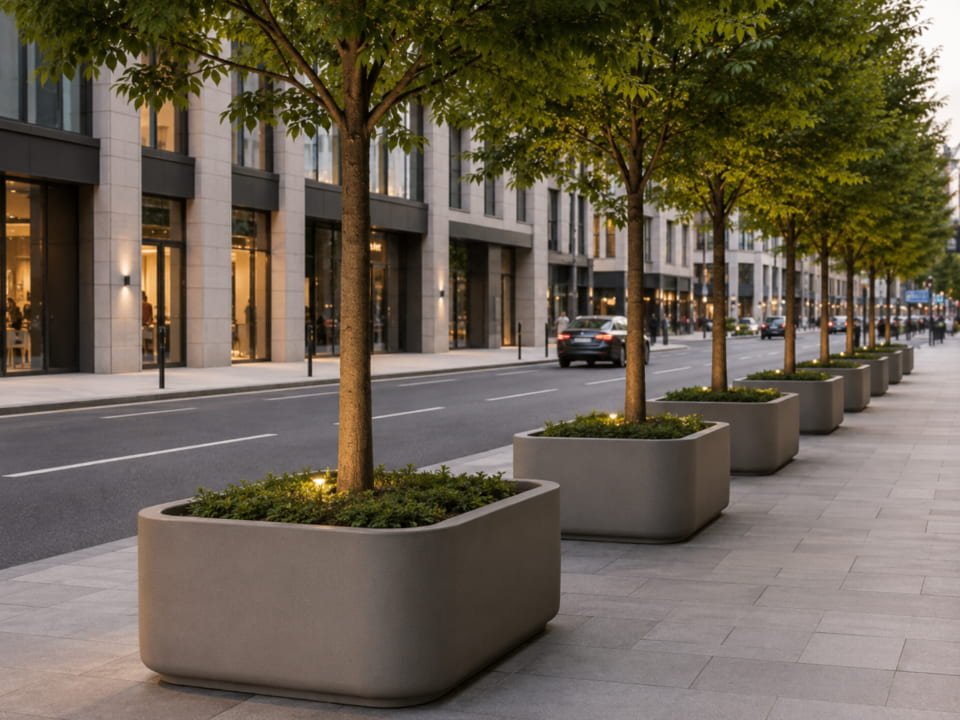
GRC planter boxes are most commonly used where buyers need three things at the same time: an architectural concrete look, lower body weight than thick traditional concrete, and enough customization to fit a real project rather than a catalog size. ACI’s current GFRC premix report places these products in architectural, civil engineering, construction, and landscaping applications, and describes their value in terms of strength, toughness, durability, moisture resistance, dimensional stability, fire resistance, and aesthetics.
From an export-sales perspective, the most frequent applications are commercial plazas, rooftop gardens, hotel and resort entries, shopping malls, streetscapes, municipal parks, high-end residential developments, and corporate campuses. The reason is practical: those projects usually care about finish consistency, custom dimensions, drainage details, lifting limits, and transport risk just as much as they care about appearance.
Questions That Actually Matter
If you are buying planter boxes for a commercial project, “where can GRC be used?” is really a deeper question.
You are usually asking whether the material will work for your site conditions.
Will it be too heavy for a roof deck?
Will the finish still look consistent across 40 or 80 units?
Will the planter survive ocean shipping without chipped corners?
Will drainage details coordinate with paving, waterproofing, or irrigation?
Those are the questions that matter in actual procurement.
Where GRC Planters Fit Best
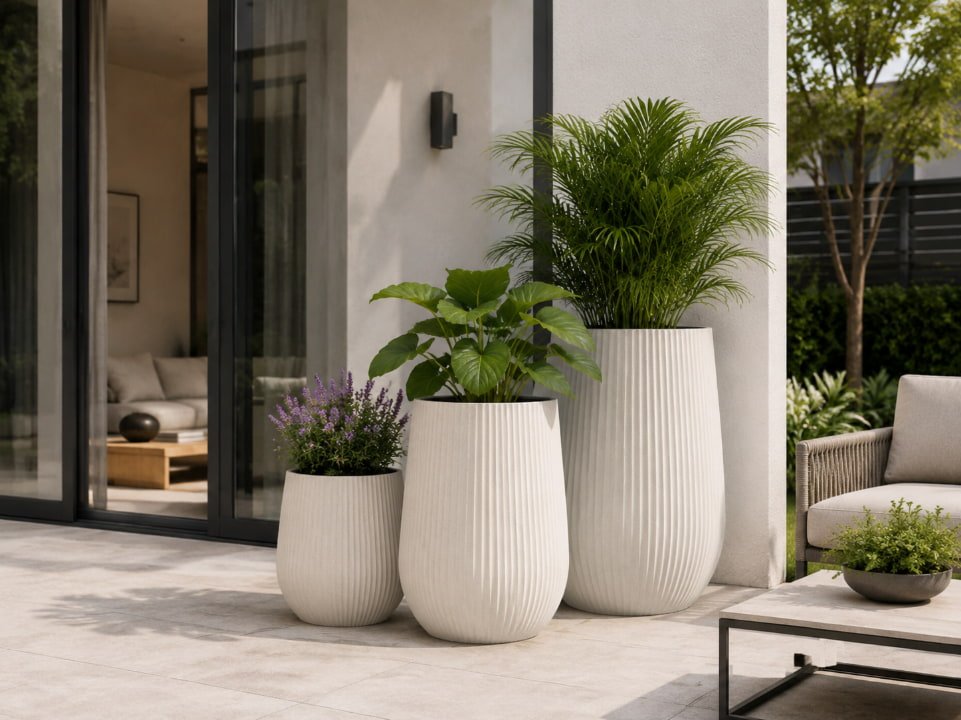
GRC planter boxes are commonly used in commercial plazas, rooftop gardens, hotels and resorts, shopping malls, streetscapes, municipal parks, high-end residential developments, and corporate campuses. They fit these applications because GRC can combine architectural appearance, reduced section thickness, good outdoor durability, custom sizing, and project-specific drainage and finish options, while GRCA and ASTM guidance also support formal manufacturing, quality control, handling, and testing processes.
What ACI Says About GRC Applications
ACI’s current report on AR glass fiber-reinforced concrete premix explicitly identifies architectural, civil engineering, and landscaping products as established application groups. That broad range matters for planter buyers because planters sit right at the edge of those categories: they are architectural enough to affect design, civil enough to raise handling and durability questions, and landscape-specific enough to require drainage and maintenance planning.
The quickest way to evaluate common use cases is to look at application type first, then match the material to the buyer’s main concerns.
| Application type | Weight concern | Finish concern | Customization concern | Drainage concern | Shipping concern |
| Commercial plazas and malls | Medium | Very high | High | High | High |
| Rooftop gardens | Very high | Medium | High | Very high | High |
| Hotels and resorts | Medium | Very high | High | High | Medium |
| Streetscapes and municipal parks | Medium | High | Medium | High | Medium |
| High-end residential | High | Very high | High | High | Medium |
| Corporate campuses | Medium | High | High | Medium | High |
This table is a buyer-side comparison based on the material and project controls described by ACI and GRCA, combined with the typical risks I see in export planter procurement.
Commercial plazas and malls
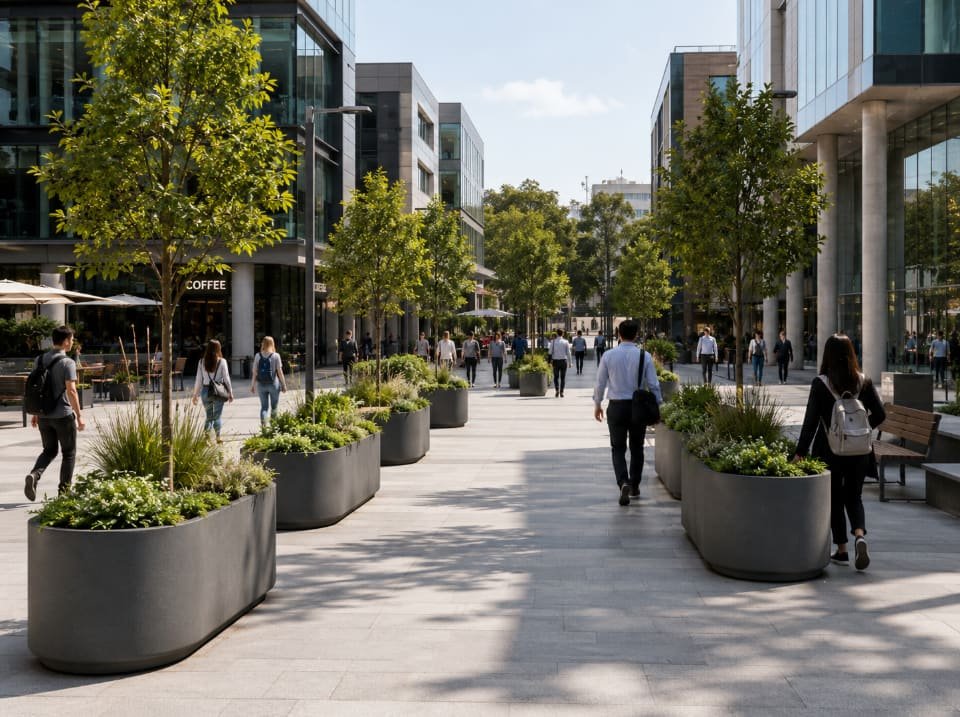
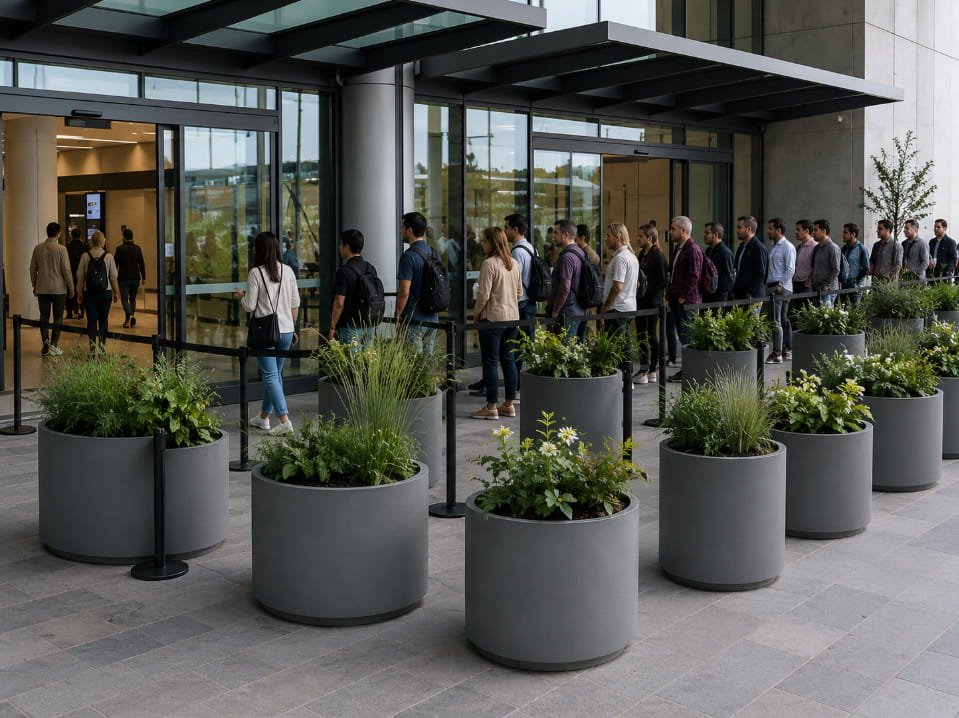
Commercial plazas and malls are one of the most common settings for GRC planters because these projects often need repeated units with a clean, architectural finish. ACI notes that GFRC premix is used for architectural and ornamental precast products, which fits well with planter walls, entry features, and integrated landscape elements that need to look intentional rather than temporary.
In this application, finish consistency usually comes before everything else.
You may need 20, 50, or 100 planters spread across multiple entrances or tenant zones. GRCA specifically notes that pigments may be used to produce colored GRC, but color variation can occur and the acceptable range should be agreed between purchaser and producer. That is why sample approval matters much more in mall and plaza projects than many buyers expect.
Drainage also needs to be coordinated early.
If the planter sits on finished paving, the design team should confirm hole location, overflow behavior, staining risk, and whether feet or a recessed base are needed to keep water from sitting under the unit. GRCA also requires that handling and transport avoid overstressing, edge damage, staining, and twisting, which is especially relevant when a single shipment contains many repeated show-face pieces.
Rooftop gardens
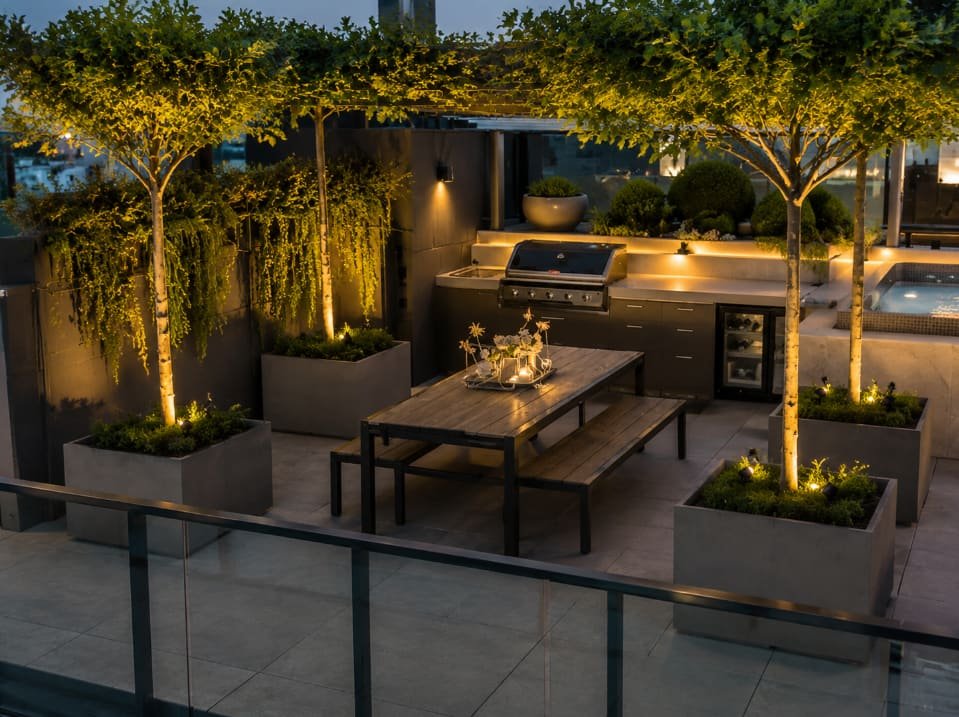
Rooftop gardens are probably the clearest use case where GRC’s reduced section thickness becomes commercially valuable.
ACI describes GFRC premix as widely used in architectural and construction applications and credits it with a useful balance of strength, durability, moisture resistance, and dimensional stability. For rooftops, that matters less as a marketing line and more as a design constraint: you want a planter body that supports the concept without consuming more dead load than necessary.
The main buyer caution is that planter weight is only part of the roof load.
EPA’s green roof guidance states that structures must be able to support the loading of green-roof materials under fully saturated conditions. In practice, the same logic applies to rooftop planters: you need to evaluate the planter, wet soil, planting media, retained water, drainage layers, and maintenance loading together.
Installation planning matters just as much as structural review.
Large rooftop planters often move through cranes, hoists, service elevators, or restricted staging areas. GRCA says large components should have handling, storage, loading, and transport methods agreed with the structural engineer, and edges and corners must be protected from damage. That requirement aligns closely with what rooftop projects need in the field.
Hotels and resorts
Hotels and resorts tend to choose GRC when they want a premium mineral finish without the mass of thick cast concrete.
ACI’s report highlights aesthetics as one of the useful balanced properties of GFRC products, and that plays directly into arrival zones, pool decks, terraces, and courtyard planting features where guests see the planter at close range.
For hospitality work, surface quality is usually the first approval milestone.
GRCA allows the use of pigments and facing coats with decorative sands or aggregates, which gives designers more room to match stone palettes, facade materials, or brand-driven finishes. At the same time, GRCA also warns that color variation may occur, so hotel buyers should insist on physical samples and a clearly documented approval standard before full production.
Drainage still matters here, even if the project focus is visual.
Poorly placed weep holes or water marks on light-colored paving can undermine a premium entrance. In my experience, resort projects benefit from reviewing drainage and finish together, not as separate line items.
Streetscapes and municipal parks
Streetscapes and parks are common applications because GRC sits comfortably between architectural and civil product logic.
ACI’s report includes both civil engineering products and landscaping products in its application structure. That is important for public-space buyers because a streetscape planter is not only decorative. It may also define pedestrian edges, green buffers, small seating zones, or wayfinding nodes.
In public projects, durability questions tend to be more practical.
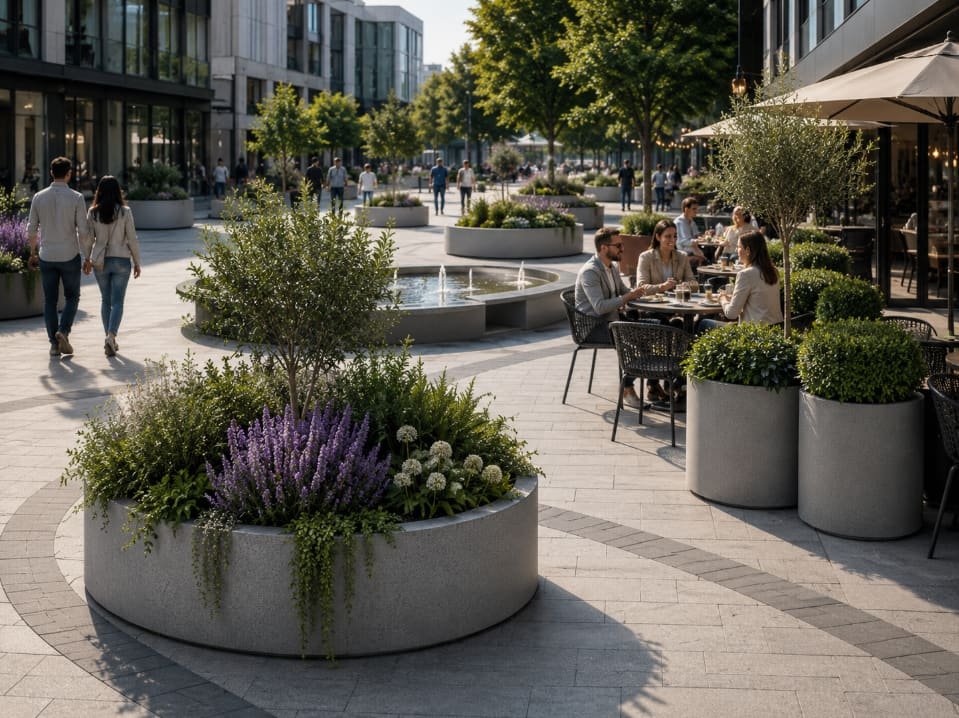
Corners should not chip during unloading. Repeated dimensions should line up with paving and site furniture. Surface finishes should be cleanable. GRCA’s handling and transport requirements are directly relevant here because they emphasize avoiding overstress, twisting, edge damage, and staining during storage and delivery.
This is also where repair planning becomes useful.
Even a well-made planter may get hit by site equipment, bicycles, or maintenance tools over time. For municipal work, I usually recommend asking suppliers whether color-matched repair material can be provided with the shipment.
High-end residential developments
High-end residential projects often use GRC planters in arrival courts, terraces, balconies, pool areas, and shared landscape decks.
These sites usually need more customization than standard-size retail planters can offer. ACI notes that GFRC premix products are selected according to the end-product requirements, and that tensile and flexural properties are influenced by fiber content, geometry, length, orientation, and mixture design. That matters because residential buyers often want slimmer profiles, longer troughs, and custom shapes that still need to survive transport and installation.
Balconies and private terraces also bring weight back into the conversation.
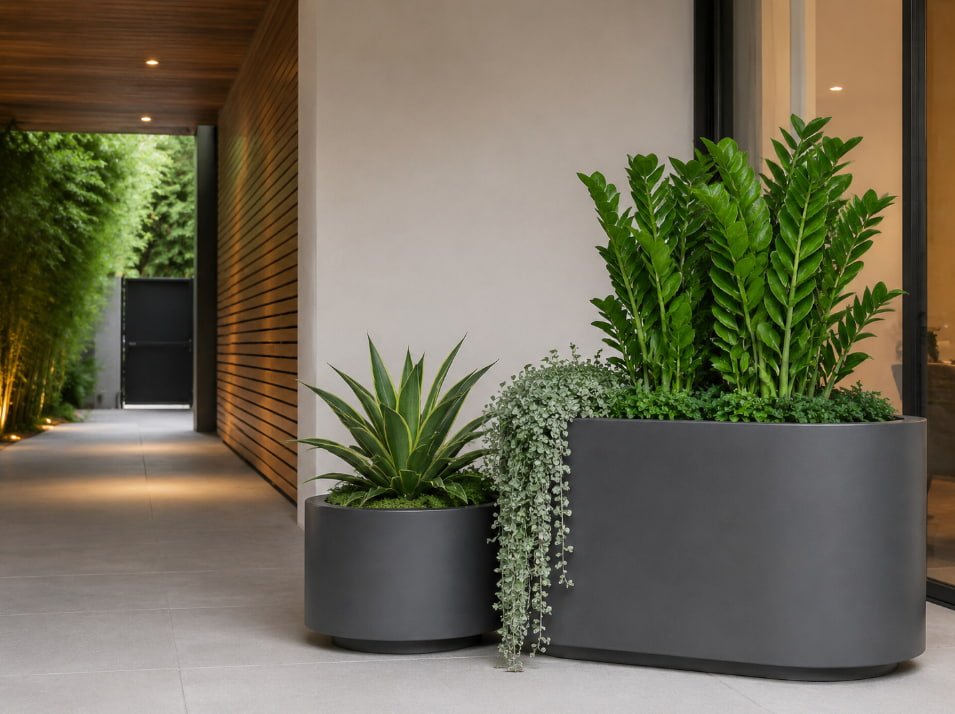
Even when the planters are smaller than plaza units, access can be harder and structural allowances tighter. That is why I usually tell residential buyers to request empty unit weight early, then confirm installed load with the project engineer if the planter sits on a balcony or elevated slab.
Finish approval is also more personal in this segment.
Developers and designers may want warmer grays, limestone-like textures, or matte charcoal surfaces. GRCA’s guidance on pigments and acceptable color variation is especially relevant when units will be viewed from only a few feet away.
Corporate campuses
Corporate campuses use GRC planters for many of the same reasons as plazas, but with one added requirement: phasing.
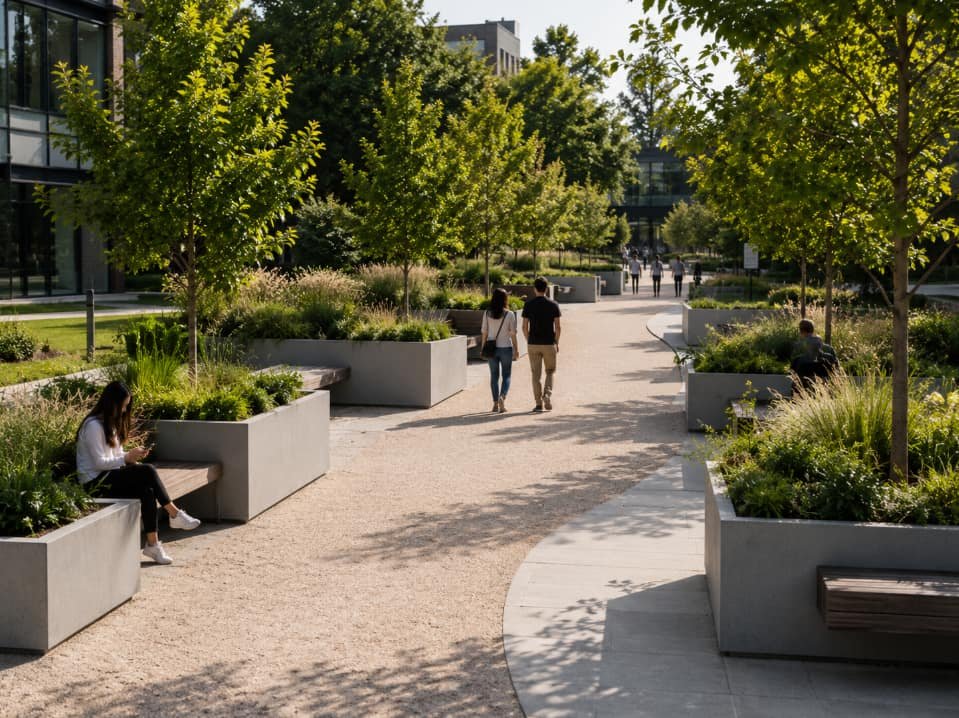
A campus may install planters across multiple building entries, courtyards, pedestrian spines, and outdoor collaboration zones over more than one project phase. That makes dimensional repeatability and finish consistency more important than the first quote sometimes suggests. GRCA’s manufacturing-tolerance section and its emphasis on a formal quality management system are relevant here.
Shipping is also a bigger issue than buyers assume.
Campus projects often involve many large, similar units moving to one site, sometimes in staged deliveries. GRCA requires the producer to store, handle, and transport components to avoid overstress, distortion, staining, and corner damage. That aligns closely with phased commercial delivery needs.
Quality Control and Testing That Matter by Application
Not every project needs the same testing package.
GRCA explicitly says its listed QC measures are the minimum and that further product-specific tests may be necessary depending on the product type, the application, and the consequence of failure. For buyers, that means a freestanding rooftop trough, a hotel entry planter, and a municipal streetscape unit should not all be reviewed the same way.
At the material level, GRCA organizes testing around AR glass fiber content, limit of proportionality and modulus of rupture, and bulk density, water absorption, and apparent porosity. Those are the tests and controls I would prioritize first because they connect directly to strength, moisture behavior, and production consistency.
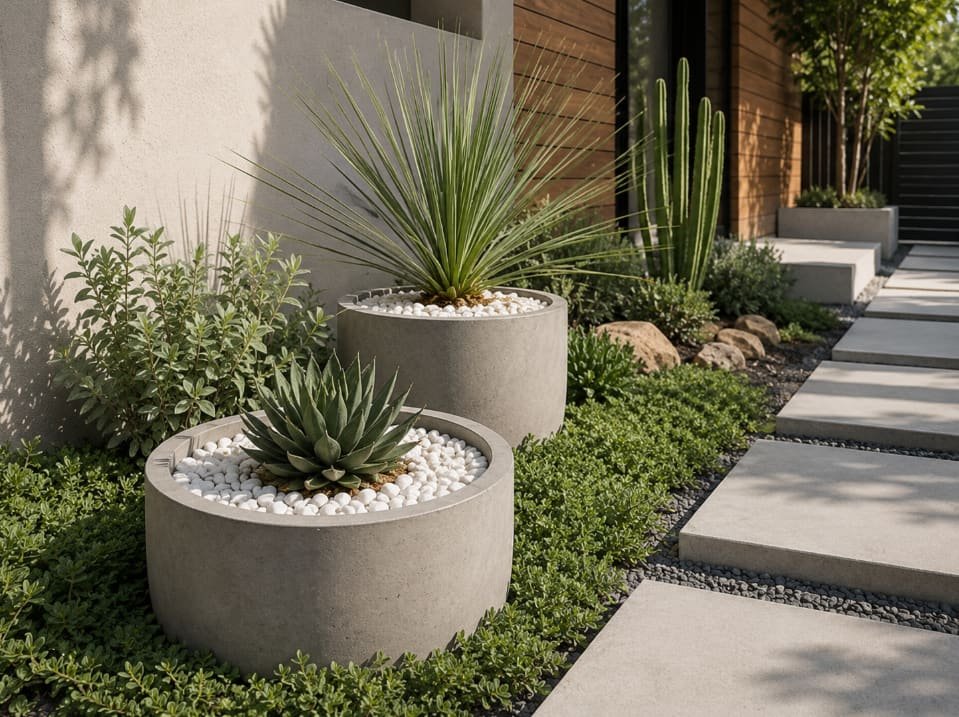
ASTM C947 is also useful in buyer conversations because it states that flexural testing of thin-section GFRC is valuable for quality control, specification compliance, research and development, and product design. That is particularly relevant for long trough planters, slim-wall planters, and custom pieces with large faces or narrow sections.
GRCA also recommends test boards made, demolded, and cured in the same way as the represented component, with a frequency of at least one board per day per mixer or pump. For repeated commercial orders, that is a practical quality-control signal worth asking about.
Common Buyer Questions and Procurement Tips
One common question is whether GRC planters are suitable for export.
They can be, but only if the supplier treats packing as part of the engineering process. GRCA’s transport guidance is clear that large components should not be overstressed, twisted, stained, or chipped in handling, and that methods for large components should be agreed in advance.
Another question is whether GRC is a good fit for premium projects.
In many cases, yes. ACI highlights aesthetics as a core property, while GRCA allows pigments and facing coats with decorative aggregates. The practical condition is that you should approve a physical sample and define acceptable color range ahead of production.
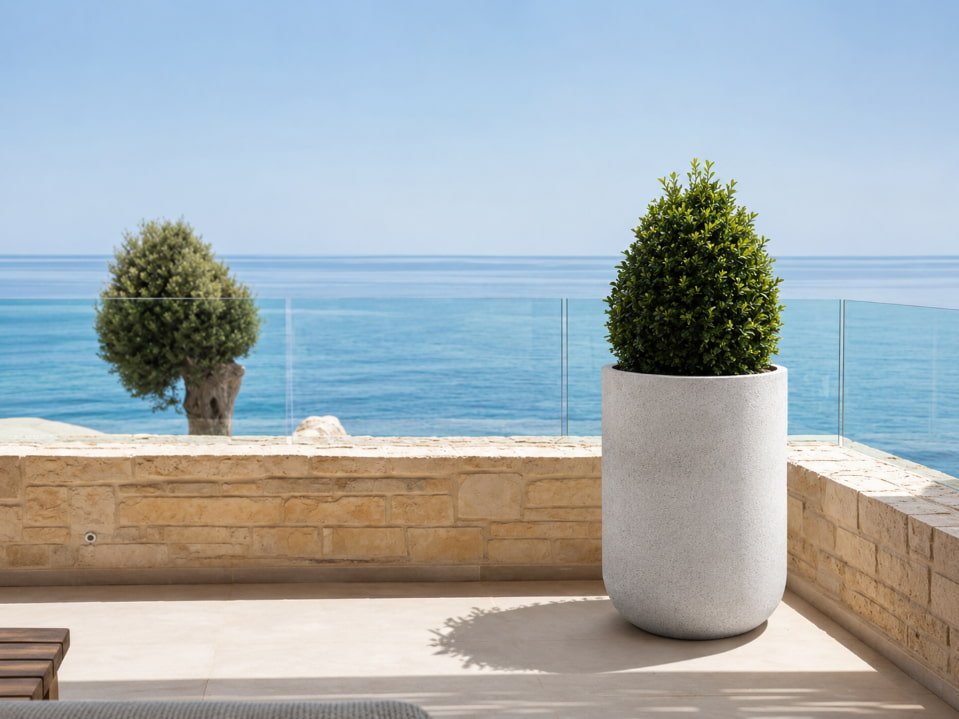
A third question is what information buyers should send first.
The most useful inquiry package usually includes drawings, dimensions, quantity, finish reference, installation location, drainage requirements, and whether the project is rooftop or ground level. GRCA’s specification repeatedly points back to purchaser-producer agreement on mix design, curing acceptability, handling method, application-specific tests, and tolerance expectations, which is why clear front-end information saves time later.
That sequence reflects the normal export rhythm I see in custom planter projects, and it lines up with GRCA’s framework for manufacture, curing, demolding, handling, transport, sampling, and testing.
Conclusion
From where I sit as a seller, GRC planter boxes are used most often in projects where the buyer cannot compromise on either design or logistics. The material earns its place when the brief calls for architectural finish, controlled weight, custom sizing, reliable drainage detailing, and export-ready handling rather than just a basic container.
Conshell is a custom GRC planter box manufacturer serving commercial landscapes, rooftop gardens, hotels, public plazas, municipal projects, corporate campuses, and high-end residential developments. We support custom sizes, shapes, colors, textures, drainage details, and export packaging based on real project requirements. Our team works with contractors, architects, developers, and procurement managers to turn drawings into buildable planter systems.
If you are planning a GRC planter project, send us your drawings, dimensions, quantities, finish requirements, installation conditions, and destination. We will review the requirements and help you assess whether GRC is the right fit for your application.
一个回复
Great content! Keep up the good work!