

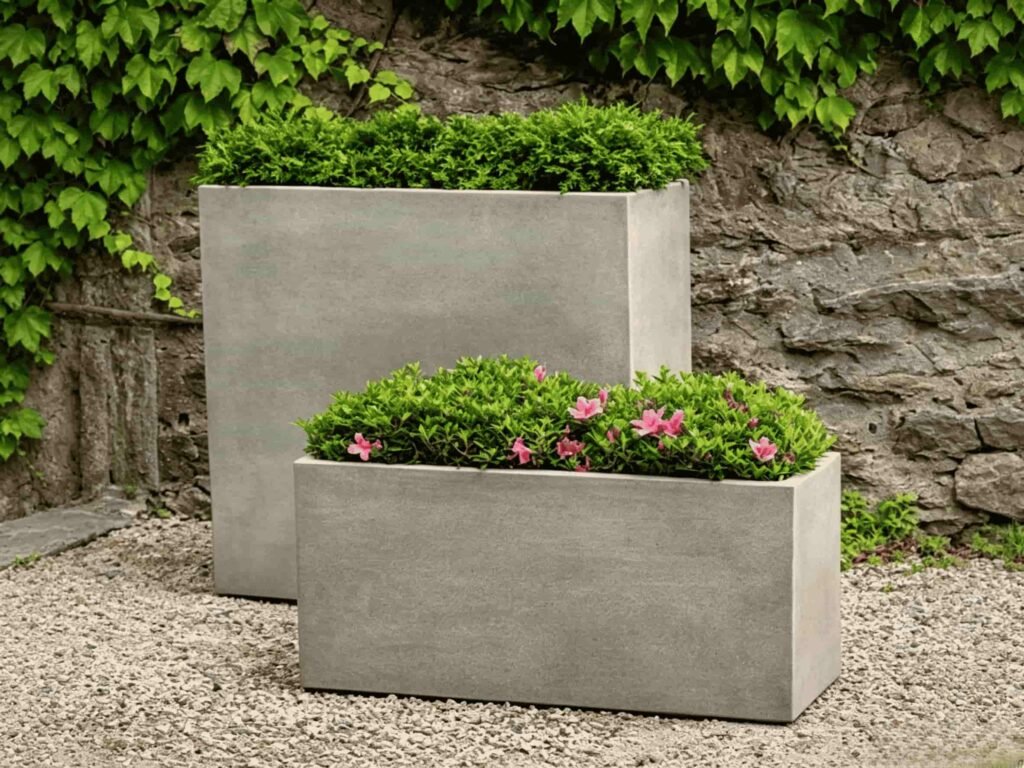
GRC and traditional concrete planters can both create a strong architectural look for outdoor spaces.
However, they are not the same in weight, production method, customization flexibility, installation efficiency, or project suitability.
If you are sourcing planters for a commercial landscape, rooftop garden, hotel entrance, public plaza, or residential development, the better choice depends on your actual project conditions.
GRC planters are usually a better choice for large commercial projects that require lighter weight, custom sizes, easier handling, and architectural finishes. Traditional concrete planters may still work well for simple ground-level projects where heavy weight and limited customization are not major concerns.
Below, we compare GRC and concrete planters from a buyer’s perspective, including material structure, weight, durability, design flexibility, shipping, installation, cost, and the type of project each material fits best.
What Are GRC Planters?
GRC stands for glass reinforced concrete. In North America, many buyers also use the term GFRC, which means glass fiber reinforced concrete.
GRC is a cement-based composite material made with cement, fine aggregate, water, admixtures, and alkali-resistant glass fibers. The Architectural Precast Association describes GFRC as a material that can be lighter and thinner than architectural precast alternatives, especially when used in thin-wall applications or projects with weight limitations.
For planter boxes, this material structure is important.
A planter must hold soil, water, plants, and drainage layers. It must also keep its shape, finish, and appearance during outdoor use. GRC helps manufacturers produce planter boxes with a concrete-like appearance while reducing unnecessary body weight.
That is why GRC planters are commonly used in commercial landscapes, rooftop gardens, hotel entrances, shopping malls, public spaces, and high-end residential developments.
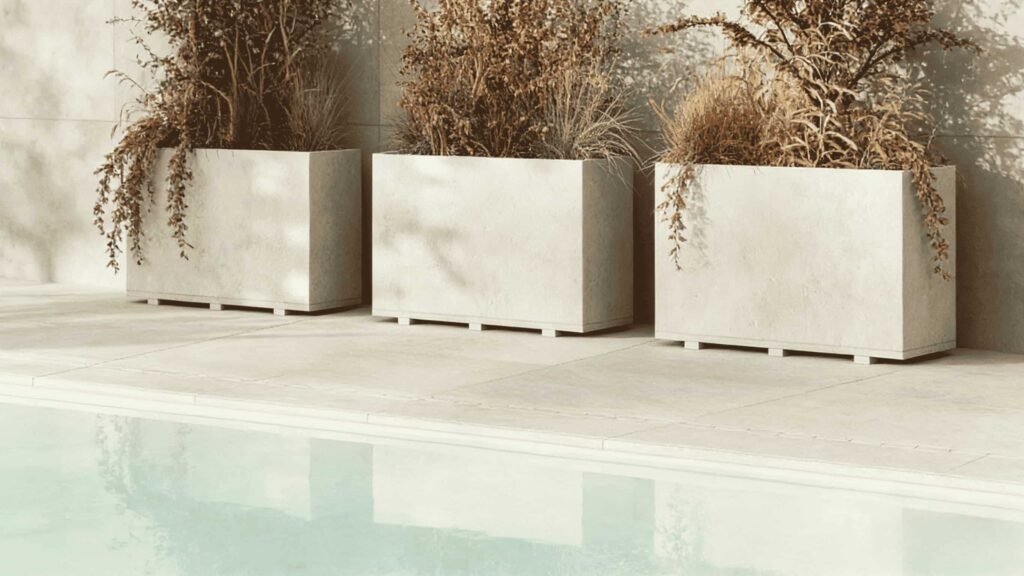
What Are Traditional Concrete Planters?
Traditional concrete planters are usually made from cement, aggregates, water, and sometimes steel reinforcement or other additives.
They are valued for their solid appearance, high mass, and familiar concrete character.
For small planters or fixed ground-level installations, traditional concrete may be a practical choice. It can look solid, feel permanent, and perform well when properly designed and cured.
The challenge appears when the planter becomes large.
A large concrete planter can be very heavy before soil, water, and plants are added. This may create problems during transportation, unloading, lifting, site movement, and installation.
For projects with limited access, elevated structures, or international shipping, weight can quickly become a serious cost and risk factor.
GRC vs Concrete Planters: Quick Comparison
| Factor | GRC Planters | Traditional Concrete Planters |
| Weight | Usually lighter | Usually heavier |
| Custom Size | Strong flexibility | Possible, but often heavier |
| Appearance | Concrete-like, architectural, customizable | Solid, heavy concrete look |
| Rooftop Use | Often more practical | May be limited by structural load |
| Installation | Easier to handle in many projects | May require heavier equipment |
| Shipping | Better for export when packed properly | Higher weight may increase handling risk |
| Cost | May cost more for custom molds and finishes | May be cheaper for simple local products |
| Best For | Commercial landscapes, rooftops, hotels, public spaces | Simple ground-level applications |
Which Material Is Better for Commercial Landscape Projects?
For most commercial landscape projects, GRC planters are often the better option.
The reason is project practicality.
Commercial projects usually require more than a planter that looks good in a photo. Buyers also need custom dimensions, consistent finishes, reliable packaging, manageable weight, clear drainage details, and predictable installation.
This is especially important for landscape contractors, building material subcontractors, developers, architects, landscape designers, and procurement managers working on larger projects.
Traditional concrete may still be suitable for simple local applications. For example, if the planter is small, standard in size, installed at ground level, and produced locally, concrete can be a reasonable choice.
But if the project requires custom sizes, lighter handling, rooftop installation, export shipping, or refined architectural finishes, GRC usually offers more practical value.
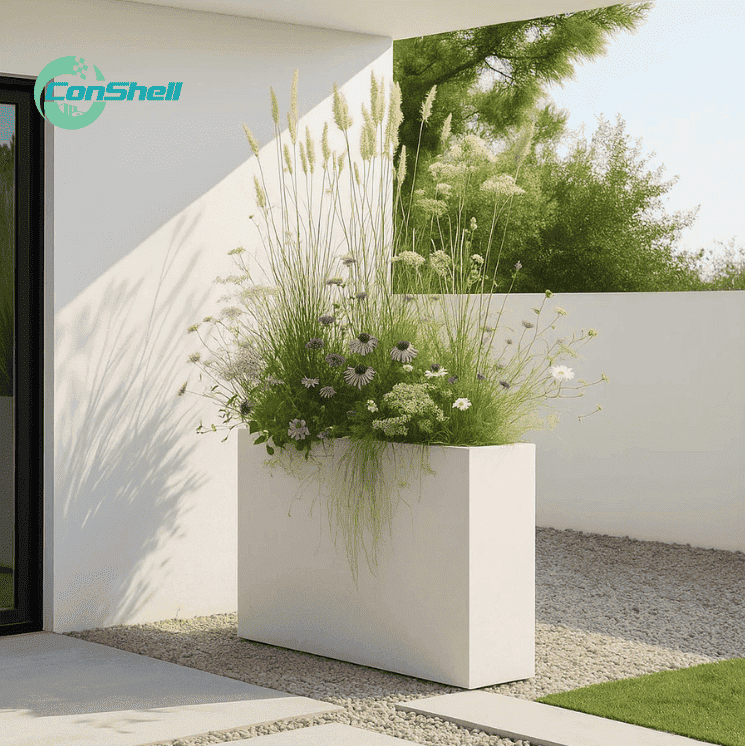
Weight: The Biggest Difference
Weight is often the first reason buyers compare GRC and concrete planters.
Traditional concrete planters become heavy very quickly as the size increases. This affects almost every stage of the project.
It affects freight cost.
It affects lifting equipment.
It affects site handling.
It affects installation speed.
It may also affect structural loading for rooftops, balconies, terraces, and podium landscapes.
GRC planters can often be made with thinner wall sections while still maintaining a strong architectural body. The GRCA specification requires alkali-resistant glass fibers to be formulated for high strength retention in hydraulic cement environments, which is one reason the reinforcement system is suitable for cement-based GRC products.
However, buyers should not only ask for the empty planter weight.
For rooftop and elevated projects, the total installed load matters. This includes the planter body, soil, water, plants, drainage layers, irrigation parts, and any internal support system.
A professional supplier should provide estimated product weight, but the project engineer should confirm the final structural load.
Durability: Which One Lasts Longer?
Both GRC and traditional concrete can be durable when they are properly designed, manufactured, cured, and installed.
The material name alone does not guarantee performance.
ACI notes that glass fiber-reinforced concrete premix products can provide a balance of strength, toughness, durability, moisture resistance, dimensional stability, fire resistance, and aesthetics for precast applications.
For planter boxes, long-term performance depends on several practical factors:
- Material formulation.
- Wall thickness.
- Curing process.
- Surface finish.
- Drainage design.
- Outdoor exposure.
- Handling during shipping.
- Installation method.
- Maintenance conditions.
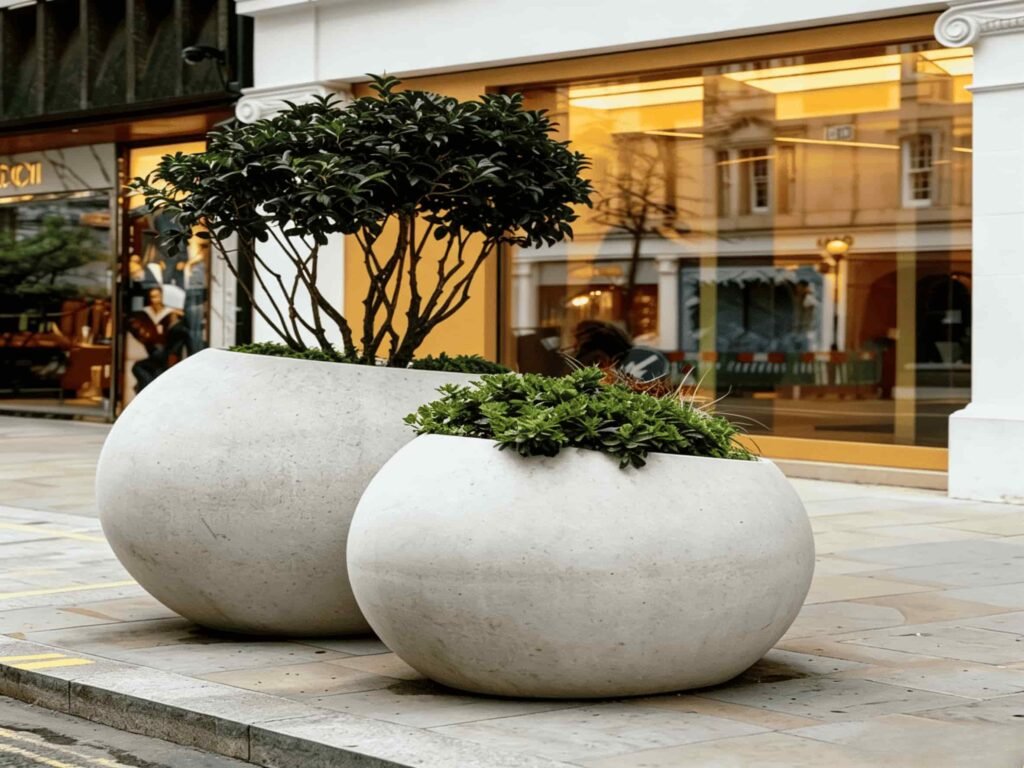
A well-made GRC planter can perform very well in outdoor commercial environments. A poorly made GRC planter can still create problems.
The same applies to traditional concrete.
For buyers, the better question is not only “Which material is stronger?”
The better question is “Which supplier can control production quality, drainage details, finish consistency, and packaging for my project?”
Customization: GRC Has More Flexibility
GRC usually provides better flexibility for custom planter projects.
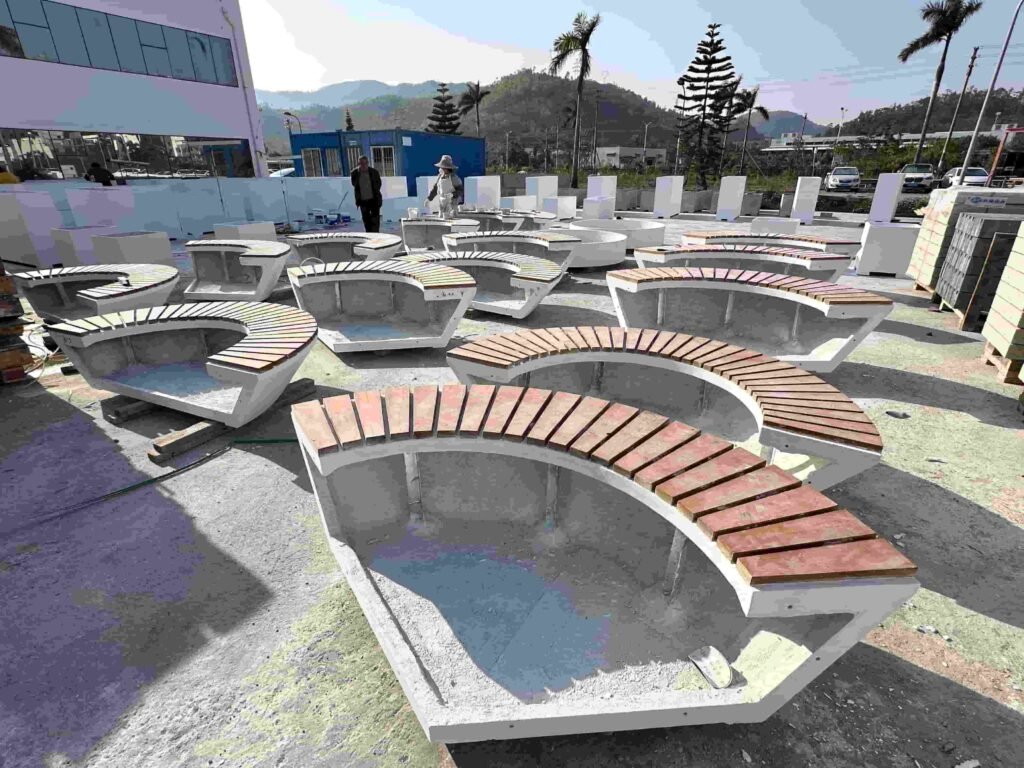
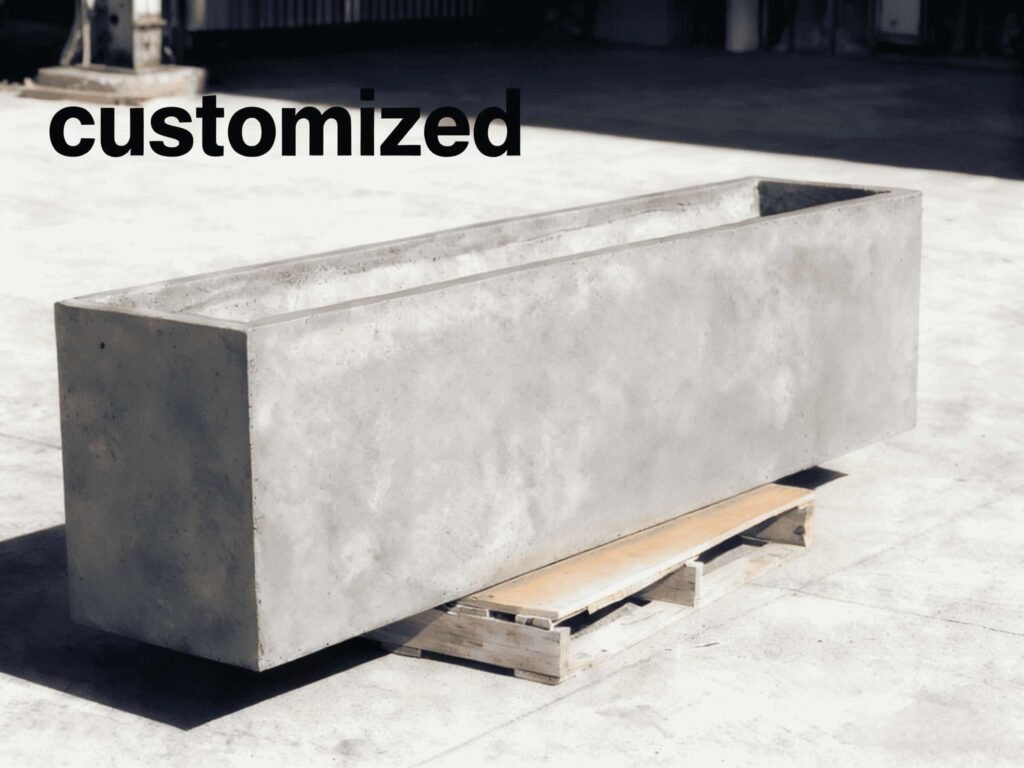
Because GRC is produced with molds, manufacturers can create a wide range of shapes and sizes. Common options include rectangular planter boxes, square planters, round planters, long trough planters, curved planters, L-shaped planters, irregular planters, and planter bench systems.
This is useful when the planter must match the project layout.
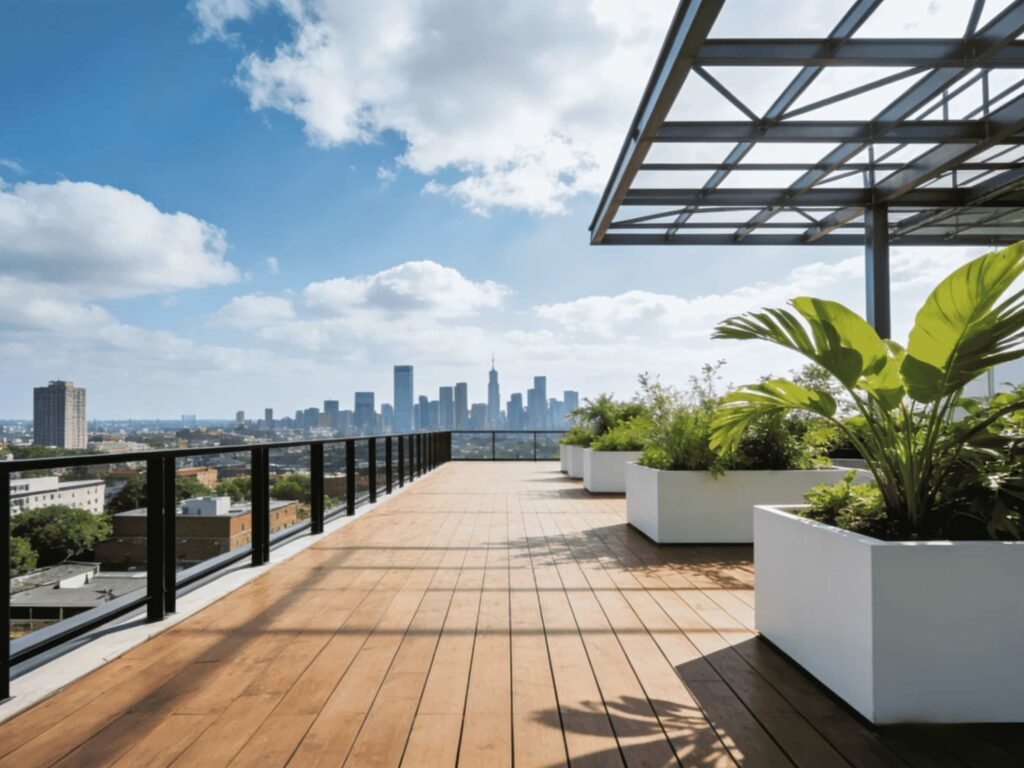
For example, a hotel entrance may need large planters with a clean premium finish. A rooftop garden may need lightweight rectangular planters with drainage details. A public plaza may need a series of custom modules that align with paving and seating areas.
Traditional concrete can also be customized, but large custom concrete planters often become very heavy. That extra weight may increase transportation cost, lifting difficulty, and installation risk.
Appearance: Both Can Look Good
The better appearance depends on the design intent.
Traditional concrete has a heavy and solid character. It works well when the project wants a raw, permanent, or industrial look.
GRC can provide a similar concrete-like appearance, but with more control over shape, texture, color, and surface finish.
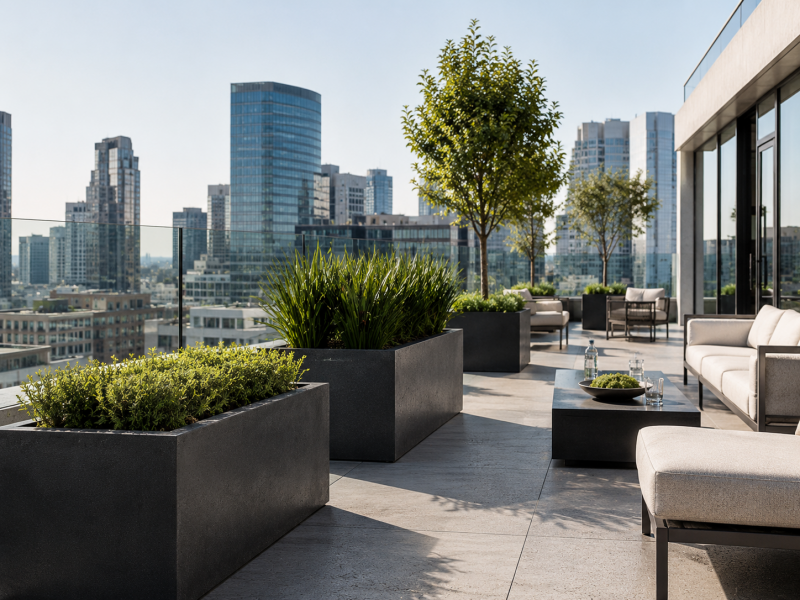
GRC planter boxes can be produced in smooth gray, dark charcoal, warm stone, sandblasted texture, matte finish, or custom colors based on project samples.
For commercial projects, consistency is often more important than one perfect sample.
If a project needs 50, 100, or 300 planters, the supplier must control color, texture, edge quality, and dimensions across the full production batch.
This is why sample approval is important.
Photos are helpful during early communication, but physical samples are better for final confirmation.
Installation: GRC Is Often Easier to Manage
Installation is another area where GRC often has an advantage.
Because the product body can be lighter, GRC planters are often easier to unload, move, lift, and position on-site.
This is useful for projects with limited access, such as rooftop gardens, terraces, courtyards, high-rise developments, and completed commercial spaces.
Traditional concrete planters may require heavier lifting equipment, more workers, stronger support, and more careful site planning.
However, GRC still requires proper handling.
Large planter boxes can be damaged if they are dropped, poorly supported, or moved incorrectly. Corners, rims, and finished surfaces should be protected during unloading and installation.
Shipping: GRC Is Usually Better for Export Projects
For international buyers, shipping is not a small detail.
Planters are bulky products. Even when the planter body is lighter, the product still occupies container space.
GRC may reduce weight compared with traditional concrete, but packaging design remains critical.
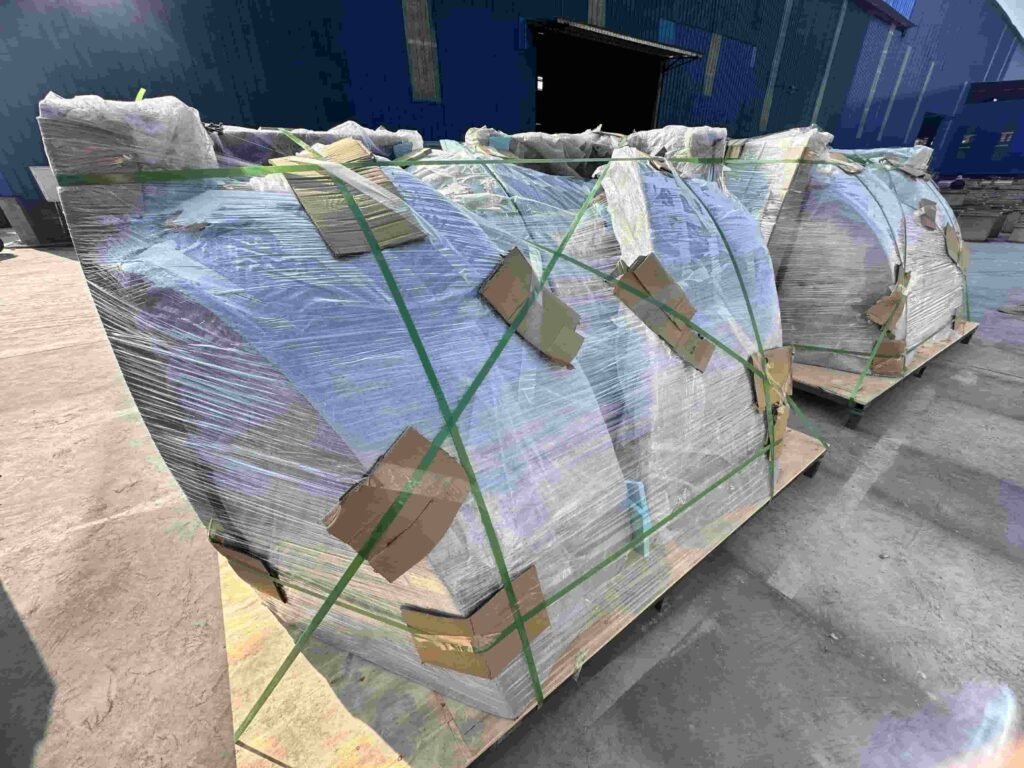
A reliable supplier should consider crate size, internal support, corner protection, surface protection, forklift access, loading sequence, and unloading instructions.
For export orders, buyers should request packing photos and loading photos before shipment.
Traditional concrete planters can be more difficult to ship because of higher weight and handling risk. GRC is usually more practical for overseas projects, but only when the packaging is properly designed.
A well-made planter with poor packaging is still a risky order.
Cost: Compare Total Project Cost
Traditional concrete may sometimes have a lower initial unit price, especially for simple standard planters produced locally.
GRC may cost more when custom molds, special finishes, samples, or export packaging are required.
However, commercial buyers should not compare only unit price.
They should compare total project cost.
This includes product cost, mold cost, packaging, freight, unloading, installation, damage risk, maintenance, and replacement risk.
In many commercial projects, a slightly higher product cost may be reasonable if it reduces installation difficulty, lowers shipping risk, improves finish consistency, and supports the project schedule.
When Should You Choose GRC Planters?
GRC planters may be the better choice if your project requires:
- Large planter sizes.
- Custom dimensions.
- Custom colors or textures.
- Reduced product weight.
- Rooftop or terrace installation.
- Long-distance shipping.
- Commercial landscape quality.
- Repeated quantities.
- Architectural appearance.
- Integrated planter bench systems.
- Consistent finish across the project.
GRC is especially suitable for commercial plazas, rooftop gardens, hotel entrances, shopping malls, public spaces, residential developments, and streetscape projects.
When Should You Choose Traditional Concrete Planters?
Traditional concrete planters may still be suitable if your project requires:
- Simple standard shapes.
- Ground-level installation.
- Local production.
- A very heavy fixed planter.
- Minimal customization.
- Short-distance transportation.
- A raw concrete appearance.
- A lower initial product budget.
For small projects where weight, shipping, and customization are not major concerns, traditional concrete may still be practical.
Buyer Questions Before Making a Decision
Before choosing between GRC and concrete planters, buyers should review several questions.
Where will the planters be installed?
Are they for ground level, rooftop, terrace, or podium use?
What size and quantity are required?
Does the project need custom shapes or standard sizes?
How important is finish consistency?
What is the shipping distance?
What lifting equipment is available on-site?
Does the project require drainage holes, internal waterproofing, or raised base details?
What is the total landed cost, not just the unit price?
These questions help buyers avoid choosing a material based only on appearance.
Common Mistakes Buyers Should Avoid
The first mistake is comparing only material names.
“GRC” and “concrete” are broad terms. The final quality depends on mix design, production method, curing, surface treatment, quality control, packaging, and supplier experience.
The second mistake is ignoring weight until installation.
Weight should be reviewed before production. Late-stage weight problems may affect structural review, lifting equipment, schedule, and labor cost.
The third mistake is approving color only by photos.
Lighting and screen differences can change how a finish looks. For important projects, a physical sample is safer.
The fourth mistake is underestimating packaging.
Export planters need proper protection. Corners, rims, surfaces, and irregular shapes should be protected based on the shipping route.
Final Recommendation
For large commercial landscape projects, GRC planters are usually better when buyers need reduced weight, custom sizing, architectural appearance, easier handling, and reliable export delivery.
Traditional concrete planters can still be suitable for simple ground-level projects where weight and customization are not major concerns.
The best choice should come from project conditions, not only from material preference.
Conclusion
In commercial landscape projects, the better planter material is the one that reduces project risk while still meeting the design intent. From a supplier’s perspective, GRC often provides more practical value when buyers need large sizes, custom finishes, lighter handling, and reliable export delivery.
Conshell is a custom GRC planter box manufacturer providing durable, lightweight, and project-specific planter solutions for commercial landscapes, rooftop gardens, hotel entrances, public plazas, and high-end residential developments. We support custom sizes, shapes, colors, surface finishes, drainage details, and export packaging based on project requirements. Our team works with architects, contractors, developers, landscape companies, and procurement teams to turn design concepts into buildable planter systems.
If you are comparing GRC and concrete planters for an upcoming project, send us your drawings, dimensions, quantity, finish requirements, and project location. We will review your requirements and recommend a suitable planter solution for your project.